Sortation for fulfilment centers
High-throughput, compact, modular, and brownfield-ready.
Request a demoOur Core Technology
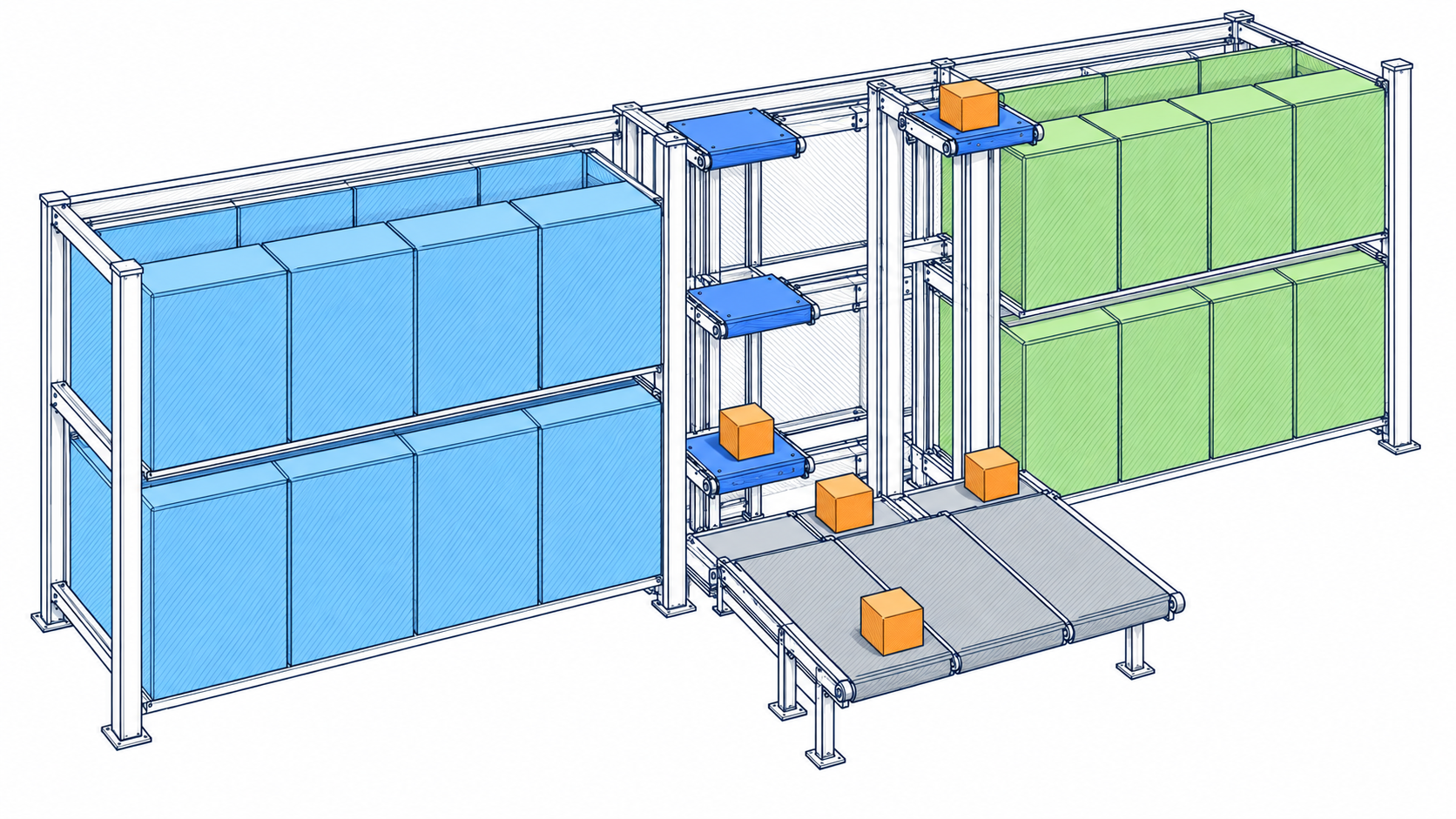
Navi is built on a decoupled multi-lift architecture — parallel induction, independent vertical lifts, and layer-matched shuttles — designed to maximise throughput and destination density in constrained brownfield facilities.

Core Technology Pillars

Decoupled Multi-Lift Architecture
Lifts and shuttles operate independently. Each lift handles vertical transport to a target layer; shuttles on that layer handle horizontal routing — so no single mechanism bottlenecks the system.

Dual-Induction, Parallel Feeding
Multiple lift stations accept parcels simultaneously. The scheduler prefers idle lifts, then routes to the station with the shortest buffer queue — keeping both induction lines continuously loaded.

Multi-Layer, High-Density Destinations
Capacity is distributed vertically across three layers without proportionally increasing floor area — 54 destination bins in a compact rail footprint.
The Sortation Flow
Every parcel moves through a tightly coupled chain of hardware modules — from floor-level induction to final bin delivery.

Vertical Induction Conveyor
Constant-speed vertical feed from floor entry to the lift pickup point. Spacing between parcels is enforced so operators can feed continuously without blocking downstream modules.

Pick-Point Buffer Queue
A horizontal buffer at each lift station decouples induction timing from lift pickup. Parcels queue safely until the lift is ready, preventing back-pressure on the induction line.

Independent Lift Stations
Each lift travels vertically to the target layer, dwells at the handoff point, and waits for the layer-matched shuttle — enabling parallel vertical transport across multiple stations.

Layer-Parallel Shuttles
One shuttle per layer moves horizontally along the rail. A shuttle picks up only when its layer matches the lift's target — then routes the parcel to the correct destination bin.

Destination Bin Matrix
Left and right bins on both sides of the rail, arranged across three layers. The matrix expands along the rail axis — add bays, layers, and stations like building blocks.
Built for Throughput & Operations
Integrated scheduling, handoff logic, and facility integration keep the system running at rated throughput with minimal operator intervention.
Smart Station Routing
When a parcel enters the system, the scheduler automatically selects the best lift station — preferring idle lifts, then the shortest end-conveyor queue.
Synchronised Handoffs
Lift-to-shuttle transfers are gated on positional alignment and dwell times. Both mechanisms must be ready before a parcel moves — eliminating dropped handoffs.
WMS-Ready Parcel Injection
Parcels are injected via a simple HTTP API with a target bin ID. The system validates destinations and accepts parcels while the sorter is running.
Live Throughput & Utilisation
Real-time tracking of parcels delivered, in-system count, parcels per hour, and per-lift / per-shuttle utilisation — for ops monitoring and capacity planning.
Modular Scaling
Add bays, layers, bins, and lift stations through configuration. Scale from a single module to a full bank of sorters without redesigning the architecture.